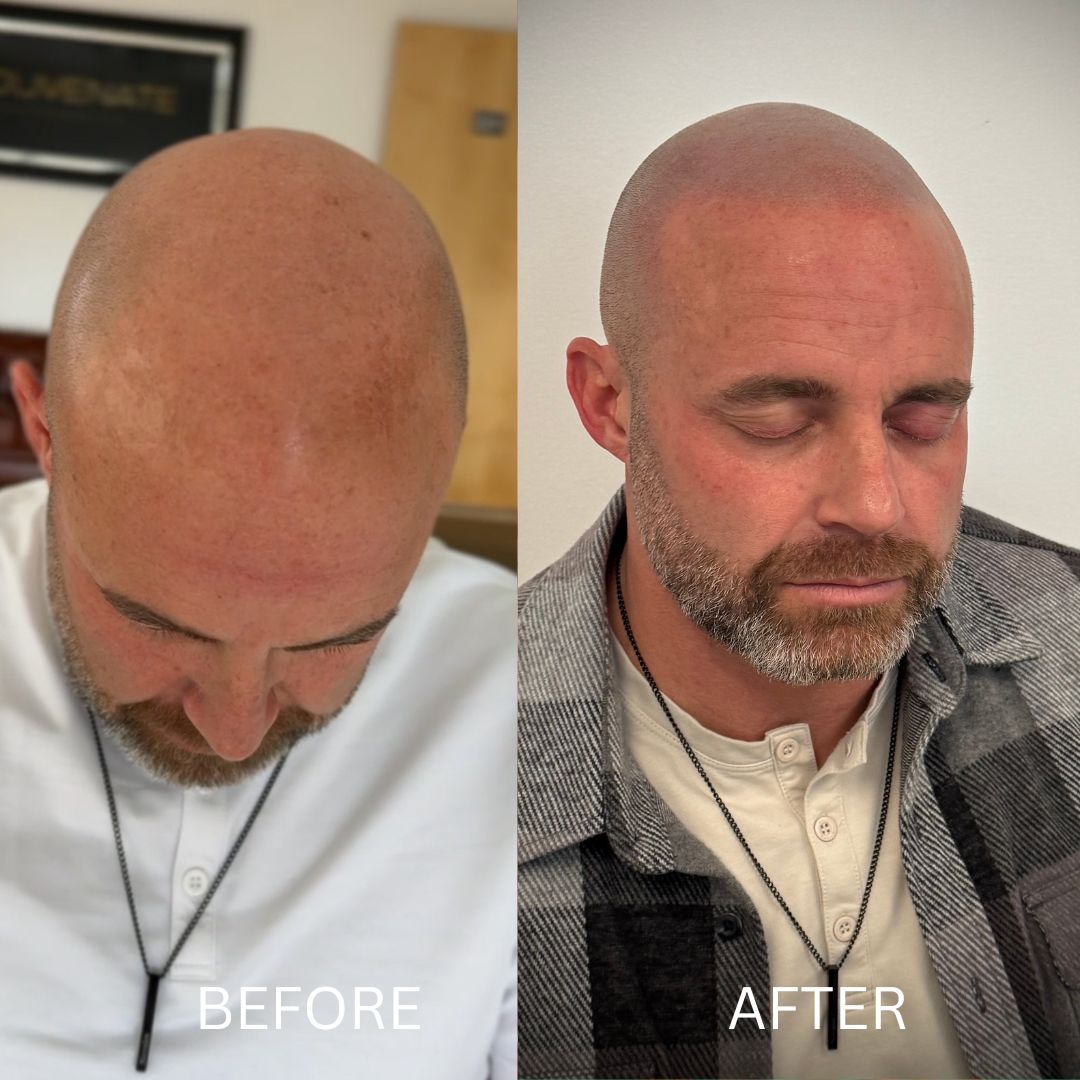
Hairline Restoration
How to Restore Your Hairline with Scalp Micropigmentation (And Look Like Yourself Again)
You've probably noticed it for a while now.
The hairline that used to frame your face has slowly crept back.
Maybe it started with a slight recession at the temples. Or thinning at the front that made your forehead look bigger than it used to.
Either way, it's changed how you see yourself.
You look older in photos. You feel less confident in meetings, on dates, or even just catching your reflection in a window.
You've tried the shampoos, the vitamins, maybe even medication. But nothing gave you back what you're really after—a sharp, defined hairline that looks natural and makes you feel like yourself again.
That's where Scalp Micropigmentation comes in.
SMP isn't about chasing the hair you used to have or pretending nothing changed. It's about restoring a clean, masculine hairline that fits your face, your age, and your life right now.
And when it's done right, no one knows you had anything done. They just notice you look sharper.
In this guide, I'm going to walk you through exactly how SMP restores a receding or undefined hairline—step by step. You'll see how the process works, what makes a hairline look natural, and why layering and custom pigment matching are the keys to results that last.
If you're tired of looking older than you are and ready to feel confident again, this is how it's done.
What You'll Learn:
Why hairline design matters more than you think—and how the wrong approach can look obvious
The role of layering in creating depth and realism (this is what separates great SMP from bad SMP)
How custom pigment matching ensures the results blend seamlessly with your skin tone and natural hair color
The step-by-step process of restoring a hairline with SMP, from consultation to final session
What to expect during healing and how long results actually last
How to know if SMP is the right solution for your specific hairline situation
Step 1: Understanding Why Hairline Design Is Everything
Before we talk about the technical process, you need to understand this:
A hairline isn't just a line.
It's the frame of your face. It affects how old you look, how balanced your features appear, and whether the result looks natural or out of place.
I've seen SMP work done by practitioners who treat every hairline the same. They create a hard, straight line that sits too low or doesn't follow the natural contours of the head.
And it's obvious.
A natural hairline has variation. It has softness at certain points and definition at others. It follows the shape of your skull, your facial structure, and your age.
When I work with a client, I don't start with a stencil or a generic template.
I start by looking at old photos if they have them. I look at their bone structure, their remaining hair, and where their hairline naturally sat before it started receding.
Then I design a hairline that fits them—not a cookie-cutter version that might work for someone else.
This is the first and most important step in hairline restoration with SMP. If the design is off, nothing else matters.
What Makes a Hairline Look Natural?
Here's what I focus on:
Placement:The hairline needs to sit where it makes sense for your age and face shape. Too low, and it looks fake. Too high, and it doesn't solve the problem.
Shape:A natural hairline isn't perfectly symmetrical. It has slight irregularities—a bit of recession at the temples, some softness in the center.
Transition:The front edge shouldn't be a hard line. It should fade slightly, mimicking the way real hair grows in at the hairline.
Getting this right takes experience. It's not something you can rush, and it's not something you want to trust to someone who's still learning.
Step 2: Custom Pigment Matching—Why One Size Doesn't Fit All
Here's something most people don't realize:
The pigment used in SMP isn't one-size-fits-all.
Your skin tone, your natural hair color, and even the undertones in your complexion all affect how pigment appears once it's placed.
If the pigment is too dark, it looks like someone drew on your scalp with a marker.
If it's too light, it doesn't create enough contrast to mimic real hair follicles.
And if the undertone is off—say, a cool gray pigment on warm-toned skin—it stands out in the wrong way.
I custom-mix pigment for every client.
I'm looking at the shade of their existing hair (if they have any), the tone of their skin, and how those two interact under different lighting.
Natural light. Indoor light. Even the way their skin changes slightly depending on the season.
This is why SMP done right blends seamlessly. You're not adding something foreign to your appearance. You're restoring something that looks like it was always there.
What Happens If Pigment Matching Is Done Poorly?
I've had clients come to me after getting SMP elsewhere, and the pigment doesn't match.
Sometimes it's too blue or too red. Sometimes it fades to a color that doesn't look like hair at all.
Fixing that is possible, but it's more work than doing it right the first time.
This is one of those areas where you don't want to cut corners. The practitioner you choose needs to understand color theory, skin undertones, and how pigment behaves long-term.
Step 3: Layering—The Secret to Depth and Realism
Here's the difference between SMP that looks flat and SMP that looks real:
Layering.
When you look at a natural hairline up close, you don't see uniform dots in perfect rows. You see variation in density, depth, and placement.
Some follicles appear closer to the surface. Some sit slightly deeper. The overall effect has dimension.
That's what layering does in SMP.
I don't just go over the hairline once and call it done. I build it up in stages, adding depth and subtle variation with each pass.
The first session establishes the foundation—the shape, the placement, the general density.
The second session adds refinement. I'm looking at how the pigment settled, where we need more definition, and where we need to soften edges.
The third session (if needed) is about perfecting the details. This is where the result goes from "good" to "you can't tell."
Why Layering Matters More Than You Think
Layering is what separates a result that looks like a tattoo from a result that looks like real hair.
It creates the illusion of depth. It mimics the way light hits natural hair follicles. And it ensures that the hairline doesn't look flat or one-dimensional under different lighting conditions.
This takes time. It takes patience. And it takes a practitioner who understands how to build realism layer by layer, not rush through the process to finish faster.
Step 4: The Consultation—Where the Process Really Begins
Before I place a single dot of pigment, we sit down and talk.
Not a sales pitch. Not a hard sell.
A real conversation about what you're dealing with, what you're hoping to achieve, and whether SMP is the right fit.
Here's what happens during the consultation:
I assess your hairline.Where has it receded? How much density is left? What's the natural shape we're working with?
I ask about your goals. Do you want a defined look, or something softer? Are you planning to keep your hair short, or do you want the hairline to blend with longer hair?
I show you what's realistic.I'm not going to promise you'll look 20 again if you're 45. But I will show you how we can restore a clean, age-appropriate hairline that makes you feel confident.
I explain the process. How many sessions you'll need. What the timeline looks like. What to expect during healing.
If SMP isn't the right solution for your specific situation, I'll tell you that too.
This isn't about convincing you to move forward. It's about making sure you have all the information you need to make a decision that feels right.
What Questions Should You Ask During a Consultation?
If you're meeting with a practitioner for the first time, here's what you should be asking:
How many hairline restorations have you done?
Can I see before-and-after photos of clients with a similar hairline to mine?
How do you approach hairline design?
What pigments do you use, and how do you match them to my skin and hair tone?
How many sessions will I need, and what's the timeline between them?
What does the healing process look like?
A good practitioner will answer these clearly and honestly. If someone rushes through your questions or makes it sound overly simple, that's a red flag.
Step 5: Session One—Laying the Foundation
This is where the work begins.
Session one is about establishing the hairline—the shape, the placement, and the initial layer of pigment.
Here's what happens:
We finalize the design.I draw the hairline on your scalp so you can see exactly where it will sit. We make adjustments until it looks right. You need to feel confident about the shape before we start.
I begin the application.Using a specialized device, I place thousands of tiny dots of pigment along the hairline. Each dot mimics a natural hair follicle.
I focus on evenness and symmetry.The goal is to create a consistent base that we'll build on in the next session.
The first session typically takes 2 to 4 hours, depending on the size of the area we're treating.
What Does It Feel Like?
Most clients describe it as uncomfortable but not painful.
It's a scratching sensation. Some areas are more sensitive than others—especially near the temples.
I work in sections, and we take breaks if you need them.
You're not going to leave session one with a finished result. The pigment will look darker than it will once it heals, and the hairline won't have the depth and realism it will have after layering.
But you'll see the shape. You'll get a sense of where we're headed.
And that's usually when it starts to feel real.
Step 6: Healing and What to Expect Between Sessions
After session one, your scalp needs time to heal.
Here's what that looks like:
Days 1-3:The treated area will be red and slightly swollen. The pigment will look darker than the final result. This is normal.
Days 4-7:The redness fades. You might notice some light flaking or scabbing as the skin heals. Don't pick at it. Let it come off naturally.
Days 8-14:The pigment lightens as your skin fully heals. This is when you'll see what the first layer actually looks like.
Between sessions, the pigment continues to settle. Your skin adjusts. And we get a clearer picture of where we need to add more density or refine the shape.
How Long Between Sessions?
I recommend waiting at least 4 to 6 weeks between sessions.
This gives your skin time to heal completely and allows the pigment to stabilize.
Rushing through sessions doesn't give better results. It just increases the risk of overworking the skin.
Step 7: Session Two—Adding Depth and Refinement
Session two is where the hairline starts to look real.
By now, the first layer has settled. I can see where we need more density, where edges need to be softened, and where we can add subtle variations to create depth.
Here's what happens:
I assess the healed result from session one.What areas need more coverage? Where does the pigment need to be slightly darker or lighter?
I add another layer.This time, I'm working more strategically—building up certain areas, softening others, and creating the kind of variation that mimics natural hair growth.
I refine the edges.The front of the hairline gets special attention. This is where a hard line can look obvious, so I work to create a soft, natural transition.
Session two usually takes 2 to 3 hours.
And this is when most clients start to see the result they were hoping for.
The hairline has dimension. It has depth. It doesn't look flat or drawn on.
It looks like hair.
Step 8: Session Three (If Needed)—Perfecting the Details
Not everyone needs a third session.
But if we're aiming for a highly defined result, or if certain areas need a bit more density, session three is where we lock it in.
This session is about refinement.
Small adjustments. Perfecting the transition zones. Making sure everything looks balanced under different lighting conditions.
By the end of session three, the result should be exactly what we discussed during the consultation.
A clean, natural hairline that fits your face and makes you feel like yourself again.
How Long Does SMP Last?
Here's the truth:
SMP is long-lasting, but it's not permanent in the way a traditional tattoo is.
Over time—usually 4 to 6 years—the pigment will fade slightly. How fast that happens depends on your skin type, sun exposure, and how well you take care of the treated area.
But fading doesn't mean it disappears or looks bad. It just means the pigment lightens.
When that happens, you can come in for a quick touch-up session to bring the density and color back.
Most clients need a touch-up every 4 to 6 years to keep the hairline looking sharp.
That's it. No daily routines. No medications. No ongoing maintenance beyond that.
Is SMP Right for Your Hairline?
SMP works for most men dealing with a receding or undefined hairline.
But it's not for everyone.
Here's when it works best:
You have a receding hairline and want to restore a defined, natural-looking edge
Your hairline has thinned to the point where it's no longer visible, and you want it back
You keep your hair short (buzzed or shaved) and want a clean, masculine look
You've tried other solutions and they didn't work or didn't feel sustainable
Here's when it might not be the right fit:
You're still actively losing hair and the hairline is changing quickly (we'd recommend waiting until it stabilizes)
You want a solution that allows you to grow long hair again (SMP works best with short styles)
You have certain skin conditions that could affect healing (we'd discuss this during the consultation)
The only way to know for sure is to sit down and talk through your specific situation.
Final Thoughts: What Restoring Your Hairline Actually Means
Here's what I've learned after working with hundreds of men who wanted their hairline back:
It's not really about the hair.
It's about how you feel when you look in the mirror.
It's about not avoiding photos. Not worrying about lighting. Not thinking about your hairline every time you meet someone new.
SMP won't give you the hair you had at 20. But it will give you a clean, defined hairline that fits who you are now.
And when it's done right—with careful design, custom pigment matching, and proper layering—no one will know you had anything done.
They'll just notice you look sharper.
More put together.
More like yourself.
If you're tired of looking older than you feel and you're ready for a solution that actually holds up in real life, this is how it's done.
No pills. No ongoing treatments. No guessing.
Just a clear process, honest expectations, and a hairline that makes you feel confident again.
Ready to See If SMP Is Right for You?
If you're curious about whether hairline restoration with SMP is the right fit for your situation, the next step is a consultation.
We'll sit down, talk through what you're dealing with, and map out exactly what the process would look like for you.
No pressure. No sales pitch. Just clear information so you can make the decision that feels right.
Contact Huber Najera to schedule your consultation and start the conversation.
